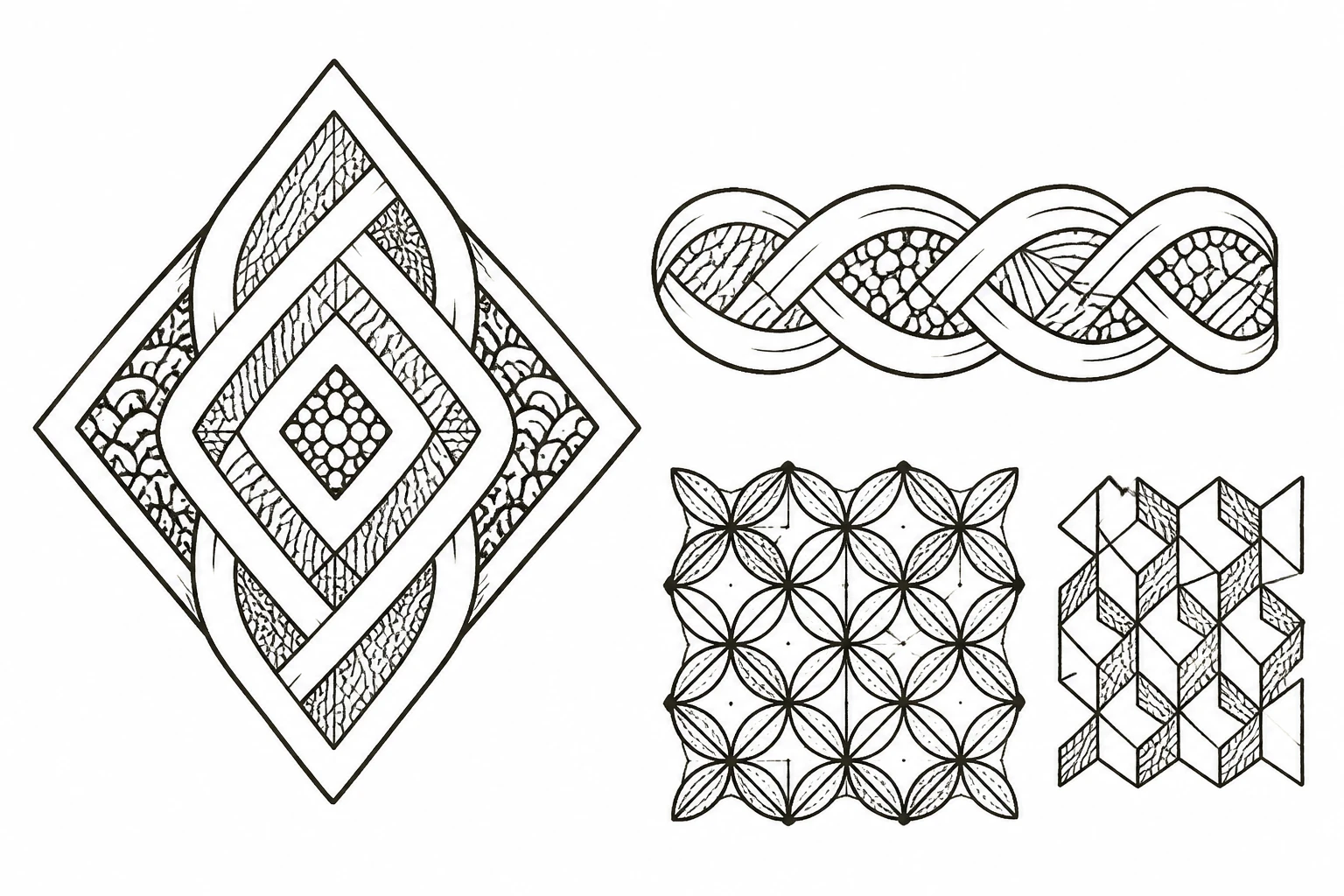
Are you craving doodles that feel both calming and endlessly decorative without drowning in detail?
Zentangle inspired shapes offer that perfect balance of structure and flow, turning simple lines into intricate patterns you can repeat across pages.
What makes these Zentangle shapes so appealing is their combination of recognizable silhouettes with modular patterns.
You can mix, match, and rotate motifs to build complex textures from just a few core ideas.
Keep reading to discover 13 unique shapes and patterns you can use as the backbone of your doodling practice.
1. Interwoven Diamonds with a Taenia Twist
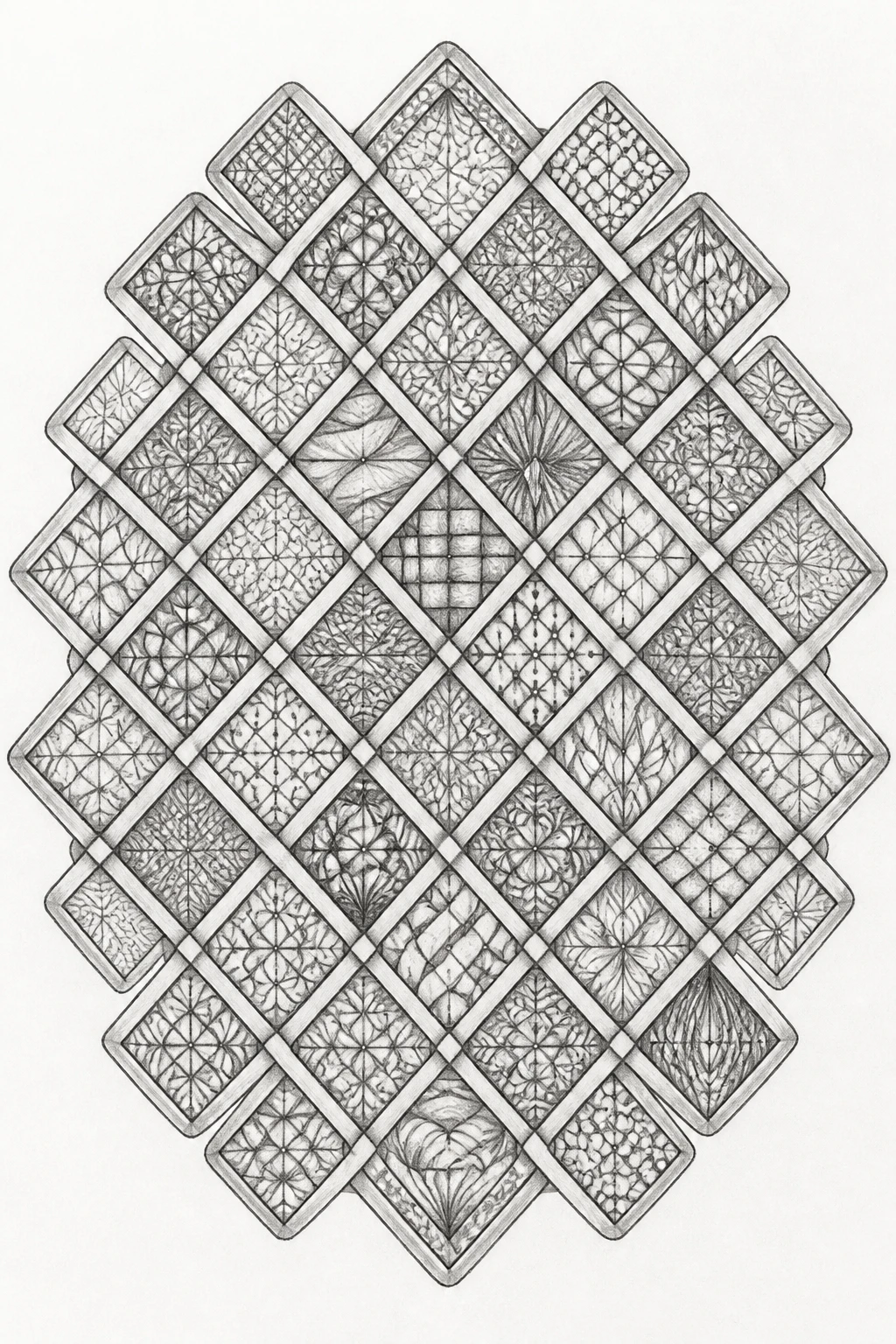
This motif centers on a tidy array of diamonds that interlace with themselves, creating a subtle lattice that feels both crisp and organic. The repeatable geometry makes it instantly recognizable and perfect for tiling across a page.
How to Draw It
- Draw a small diamond shape with pointed tips and even sides.
- Copy and rotate the diamond to form a chain that overlaps at each vertex, creating a Taenia like weave.
- Shade alternate diamonds lightly to emphasize the interlaced effect without overpowering the linework.
- Finish with a light outer outline to keep the motif clean when scaled down for pins.
Minimal color or detail keeps the look elegant. The crisp lattice silhouette is ideal for creating a bold header tile or a repeating border in a sketchbook page.
2. Crescent Tile Mosaic

Think of a crescent as a moonlight tile repeating across a surface. This pattern uses curved, overlapping crescents to form a soft, rhythmic tessellation that remains minimal yet visually satisfying.
How to Draw It
- Sketch a gentle crescent shape with a thin stroke.
- Repeat and stagger the crescents so they touch at tips, forming interconnected arcs.
- Fill the gaps with a few short lines inside the crescents to suggest shading without fuss.
- Keep the overall spacing even for a tranquil, wallpaper-like feel.
The result is a dreamy, modern texture that reads well in white space and looks great as a repeating motif on tiles or zentangle pages.
3. Constellation Dot Stripe
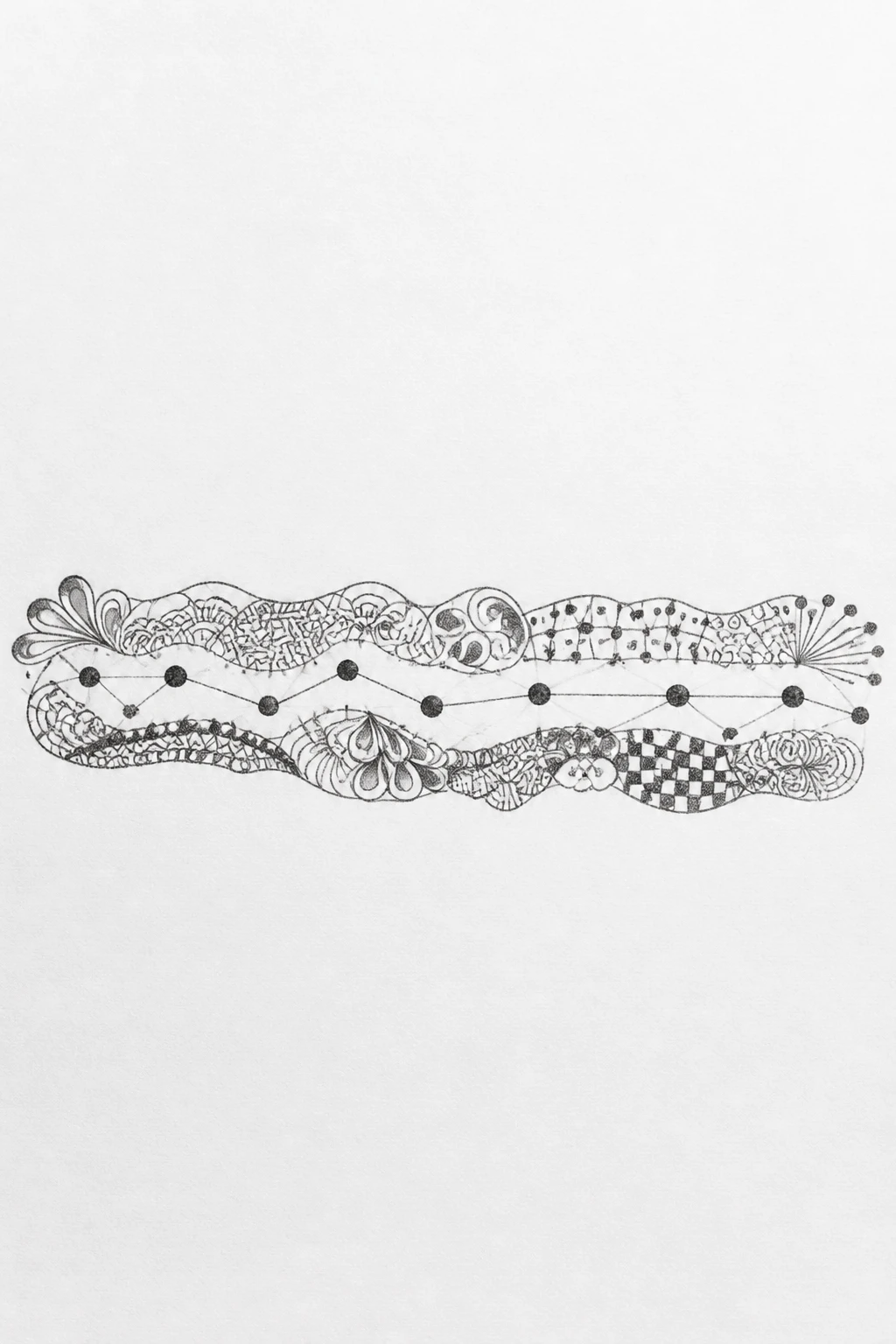
Dots arranged in a linear, starry stripe offer a quintessential Zentangle feel with a modern, graphic edge. This idea thrives on negative space and crisp, evenly spaced points.
How to Draw It
- Place a straight, light baseline across the page.
- Scatter evenly spaced dots along the line, keeping a consistent gap between each.
- Connect every few dots with a faint, diagonal line to imply a subtle constellation feel.
- Optionally thicken every other dot to create a rhythm and emphasis.
The simplicity makes it an instant pop on a Pinterest board, while the linear approach keeps it versatile for borders or header decorations.
4. Hexagonal Honey Ribbon
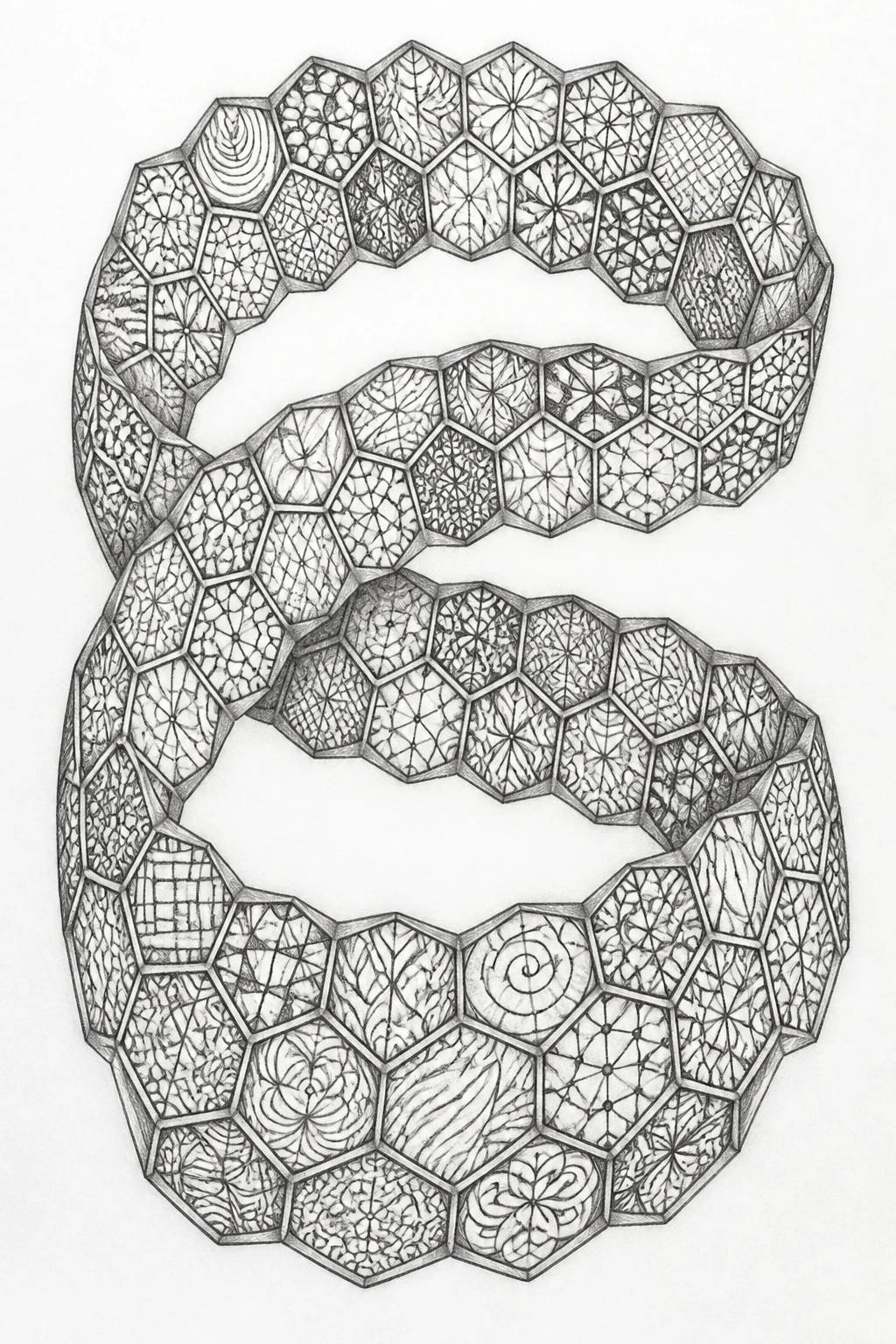
Six-sided cells arranged in a looping ribbon create a honeycomb effect that is both geometric and soft. The continuous ribbon idea lends itself to seamless tiling and visual harmony.
How to Draw It
- Sketch a single hexagon with equal sides.
- Duplicate and offset to create a honeycomb row, then curve the row into a ribbon by slightly bending the line that connects hexes.
- Join adjacent rows with short, curved connectors to emphasize continuity.
- Keep the hexagon outlines crisp, and let the ribbon breathe with light spacing between cells.
This pattern works beautifully as a repeating fill for pages, or as a border that adds a subtle geometric vibe to your doodles.
5. Teardrop Lattice Bud

Teardrops arranged in a lattice create an organic yet structured garden of shapes. This idea blends natural curves with a tidy grid for a balanced, decorative effect.
How to Draw It
- Lay out a light grid of evenly spaced points.
- Connect the points with curved teardrop shapes that nestle into the lattice intersections.
- Fill every other cell with a short hatch to imply shading and depth.
- Keep the teardrops proportional to maintain a uniform rhythm.
The lattice gives a subtle sense of texture without overwhelming the page, making it ideal for backgrounds or focal elements alike.
6. Petal Spiral Tile
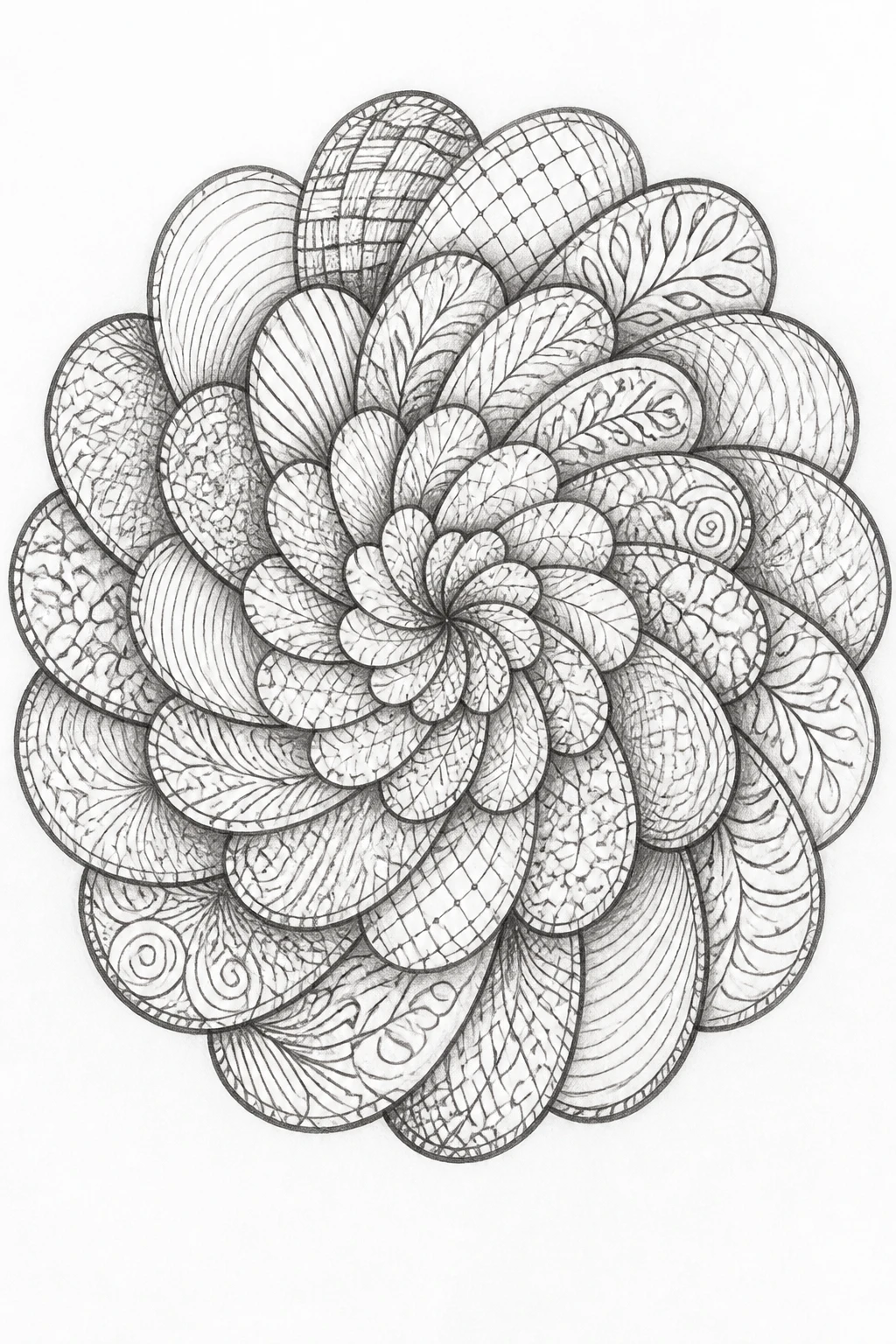
Soft petal shapes arranged in a spiral create a calm, blooming pattern that is easy to recognize and mesmerizing when repeated. The spiral adds motion while staying minimal.
How to Draw It
- Draw a small central point as the spiral origin.
- Place several teardrop petals around the center, curving them to follow the spiral path outward.
- Continue adding layers of petals around the circle, increasing the radius gradually.
- Outline the outermost petals with a clean stroke to keep the silhouette distinct.
The result resembles a flower mandala with a restrained, modern edge—great for focal points or decorative panels on pages.
7. Crescent Moon Tiles
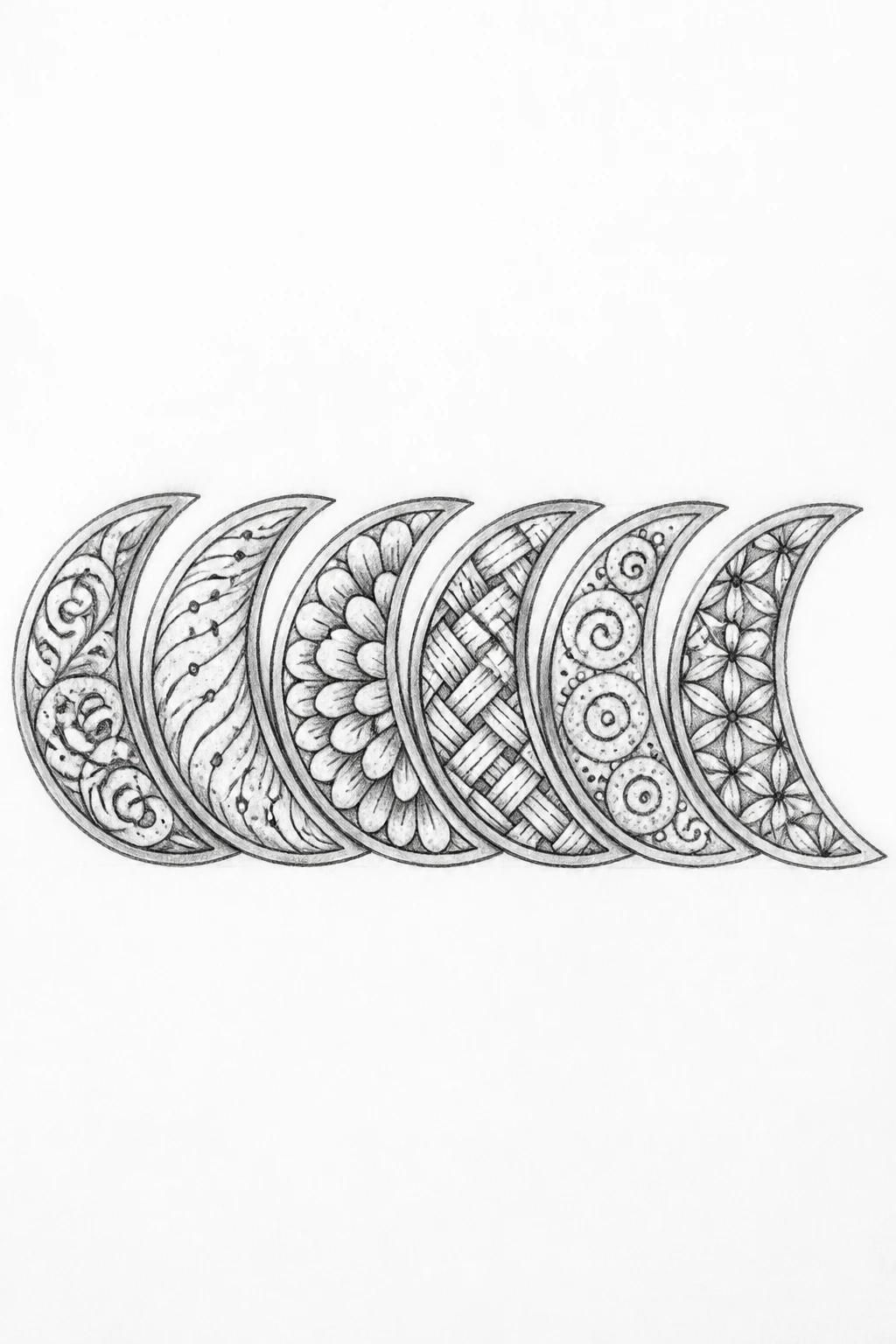
Pairing crescent moons in alternating directions creates a gentle lunar rhythm that feels playful yet refined. This idea scales well from tiny motifs to larger panels.
How to Draw It
- Draw a series of crescent shapes along a baseline, alternating their orientation.
- Let the inner curve of one crescent meet the outer curve of the next, forming a soft chain.
- Add a faint inner line to each crescent to suggest a layered, tile-like texture.
- Use a light, even stroke to maintain a clean outline for easy scaling.
Ideal for borders, corner designs, or repeating backgrounds that feel celestial without being overpowering.
8. Square Spirals in a Grid

Squares with tight spirals inside create a stark, graphic look that reads as both modern and Zentangle inspired. The combination of geometry and motion makes it a standout tile.
How to Draw It
- Draw a perfect square as the tile boundary.
- Inside, draw a tight spiral starting from the center and curling outward to the edge.
- Repeat the pattern in adjacent squares with alternating spiral directions to build a checkerboard rhythm.
- Lightly shade alternating squares to emphasize the tessellated effect.
The bold silhouette and repeating curves translate well to stickers, pins, or page dividers in a doodle spread.
9. Leafy Sheaf of Lines

A small bundle of lines arranged like a stylized leaf is incredibly simple yet highly suggestive of natural form. The concept is to imply a gentle leaf texture through parallel strokes that converge at a tip.
How to Draw It
- Draw a short, narrow triangle as the leaf silhouette.
- Inside, add several curved parallel lines from the base to the tip, staying evenly spaced.
- Finish with a thin vein line along the center to anchor the form.
- Keep the lines light so the leaf reads airy rather than heavy.
This minimalist botanical motif works well as a repeating border or as a delicate accent on a journaling page.
10. Checkerboard Vein Grid
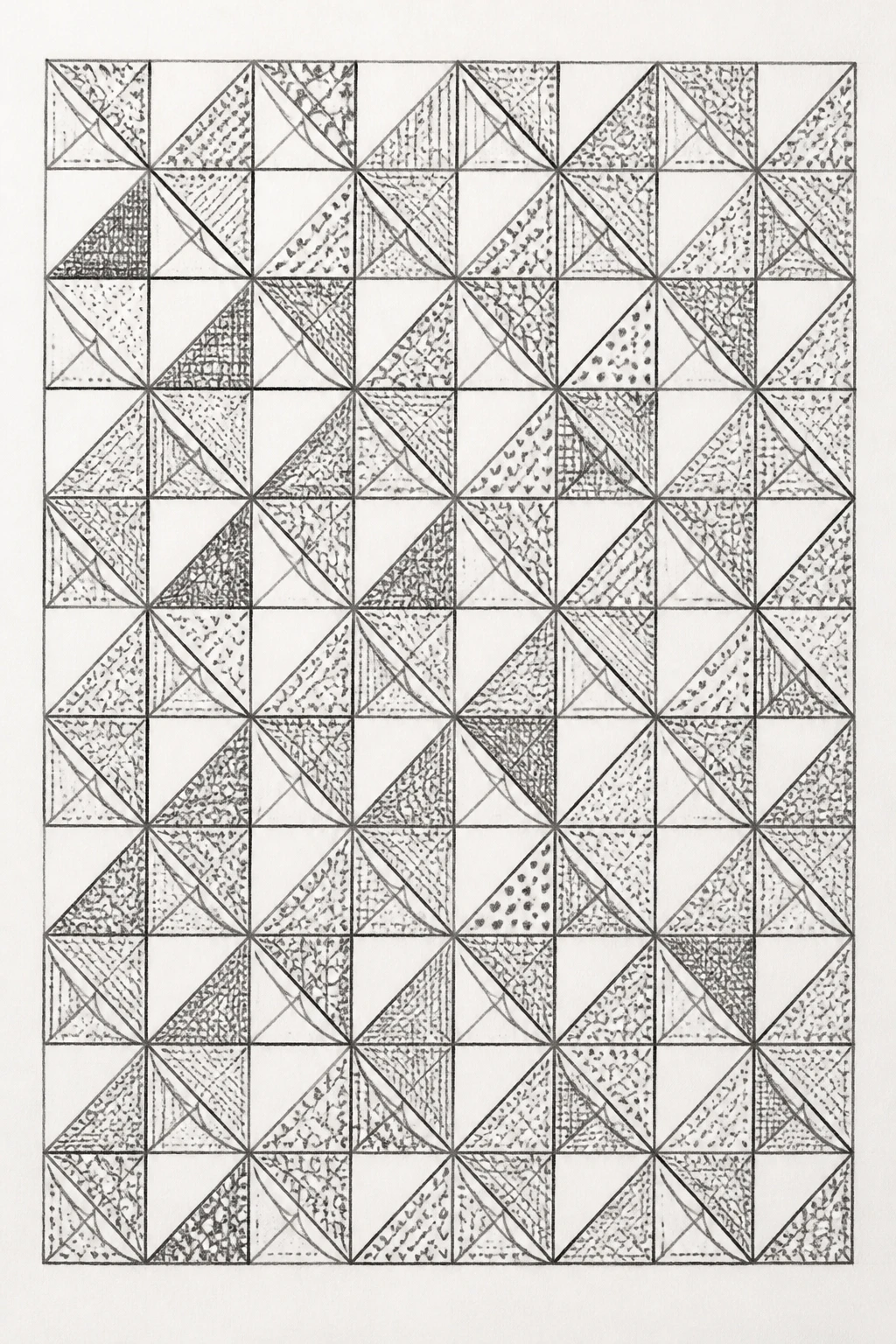
Combining small squares with diagonal vein lines creates a tessellated texture reminiscent of tiny tiles with a natural grain. It is crisp, modern, and easy to scale up or down.
How to Draw It
- Draw a tight grid of identical squares.
- Inside each square, draw a diagonal line from corner to corner to create two triangles.
- In alternating squares, add a short curved line across the diagonal to simulate a vein or shading pattern.
- Leave ample white space to keep the grid legible at smaller sizes.
The strong geometric shape and clean lines make this pattern excellent for backgrounds or page dividers in a Zentangle flavored doodle page.
11. Spiral Petal Ring
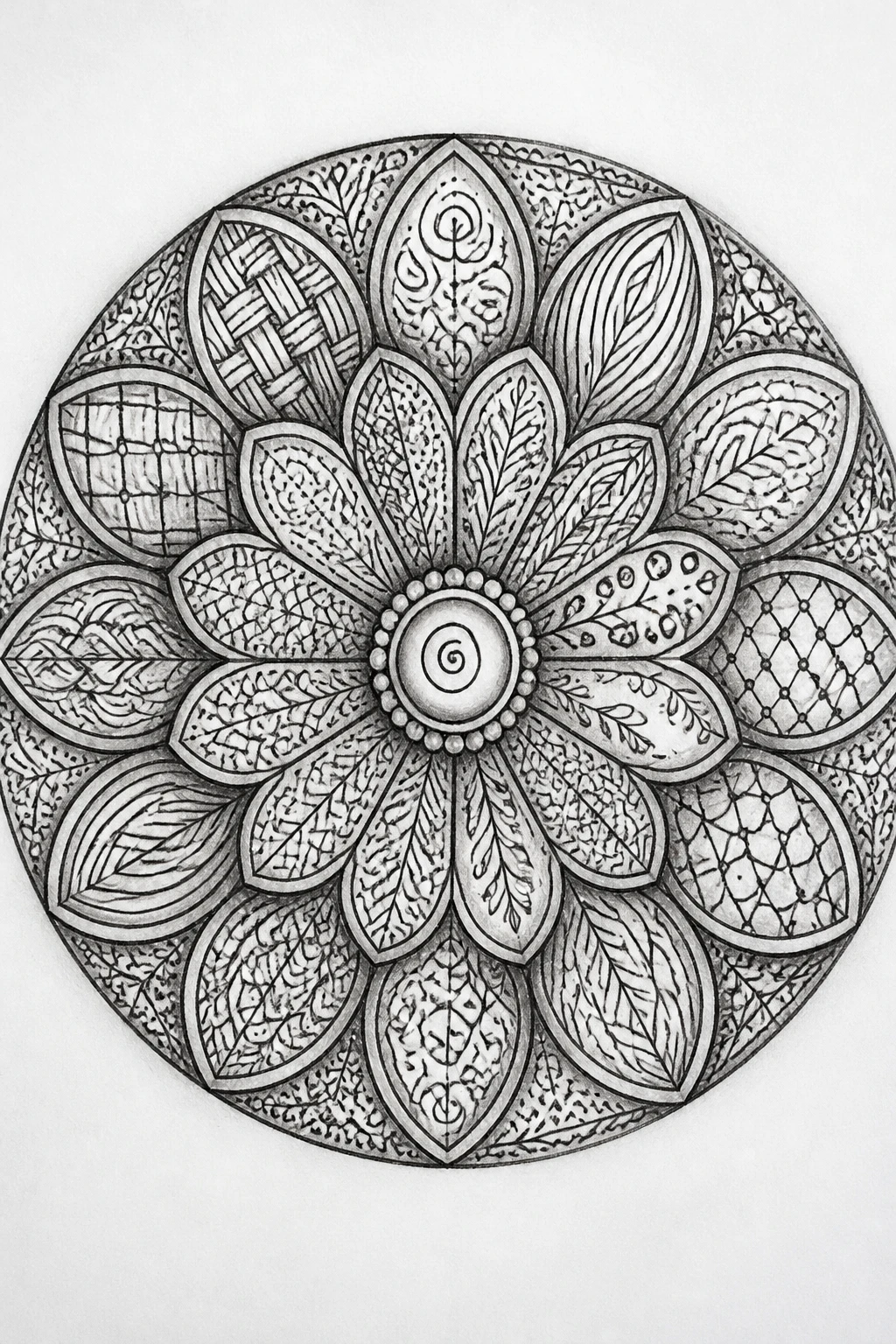
A circular ring composed of simple petal shapes creates a compact, radiant motif that feels meditative and decorative. It works as a focal stamp or a repeating motif around a central point.
How to Draw It
- Draw a small central circle as the anchor.
- Place evenly spaced petal shapes around the circle with their bases touching the center.
- Repeat a second, slightly larger ring of petals outside the first, aligning them with the gaps from the inner ring.
- Outline the outer ring to emphasize the circular silhouette and keep the inner shapes clear.
The circular symmetry and clean petals give this idea a jewel-like feel that pops on white pages and in Pinterest-ready layouts.
You May Also Like:
10 Zentangle Border Ideas for Journals and Sketchbooks
10 Zentangle Border Ideas for Journals and Sketchbooks
15 Zentangle Tree Doodle Ideas for Nature-Inspired Art
Tips for Making Your Drawings Look Cute and Clean
Start by identifying the defining silhouette of each Zentangle shape and pattern. Strong silhouettes help readers recognize the subject at a glance, especially when thumbnails appear on social feeds. Build the core outline first, then layer in only small, purposeful details that enhance the idea rather than clutter it.
Keep generous negative space around motifs so your page breathes. This is especially important for Pinterest pins where bold silhouettes read best against a simple background. Use consistent line weight throughout to maintain a cohesive look across the entire set.
Quick Drawing Tips
- Prioritize recognizable shapes and clean lines over excessive decoration.
- Experiment with line weight to create subtle emphasis without breaking the minimal vibe.
- When tiling ideas, maintain even spacing to preserve rhythm and readability.
- Try reversing light and shadow by shading alternating cells or motifs for depth.
- Save versions with and without shading to see what reads best in thumbnails.
Most importantly, let each concept keep its own identity while still feeling part of a cohesive Zentangle family. The clean match between simplicity and personality is what makes these ideas shareable and pin-worthy.
Pick Your Favorite and Start Drawing
You do not need perfect lines to create charming Zentangle inspired doodles. Focus on the core silhouette, keep the details minimal, and let each subject carry its own character.
Choose a favorite idea and give it a try in your sketchbook or on a fresh sheet of paper. Save the collection for your next drawing session, and feel free to adapt the designs while keeping each subject recognizable.
How to Make Simple Doodles Shine
Creating a visually appealing Zentangle inspired page is about balance. Start with a simple layout by deciding where your focal motif will be placed and then arrange the rest around it with even spacing. A strong focal point helps viewers understand the main subject quickly, which is especially important for Pinterest and coloring pages.
Line quality matters. Use a steady hand or a ruler for straight edges when needed, and keep curves smooth and confident. Thicker outlines around the central element and thinner lines for background details create a clear hierarchy that guides the eye naturally across the page.
Composition can elevate the 13 ideas from a list to a cohesive doodle spread. Try grouping a few motifs into clusters, then balancing them with negative space or a unifying border. If you plan to print these as coloring pages, consider leaving generous white areas between tiles to accommodate varied coloring styles.
Optional Practical Tips
- Use a light pencil guide to map grid or tiling before committing to ink.
- Create a small palette of 2 colors plus black for contrast to keep the page clean and printable.
- Experiment with alternating pattern directions to keep the page dynamic without adding clutter.
- Test each motif at different sizes to ensure legibility on both screens and prints.
- Document your process with quick photos for a Pinterest step-by-step board.
These practical approaches help you translate the 13 Zentangle Shapes and Patterns into shareable, ready-to-pin doodles that stay minimal yet visually rich.
Conclusion: Embrace One Idea and Let Your Doodles Grow
Choosing one of these Zentangle inspired ideas is a great way to begin a personal doodle journey. The patterns are designed to be friendly for beginners while offering enough depth to stay engaging as you practice and grow.
Remember that small imperfections can add personality and charm. If a line wobbles or a curve feels off, lean into it as part of your unique style. You can adapt any concept to fit your sketchbook, planner, or coloring page without losing the recognizable rhythm of Zentangle shapes and patterns. Save this collection for your next drawing session and invite a friend to try one idea with you for extra motivation.

Hi, I’m Abdul Moeed Shahid, the creator of Sketch and Fun. I’m passionate about helping people of all ages explore their creativity through fun drawing ideas and printable coloring pages. My goal is to make art simple, accessible, and enjoyable for everyone!