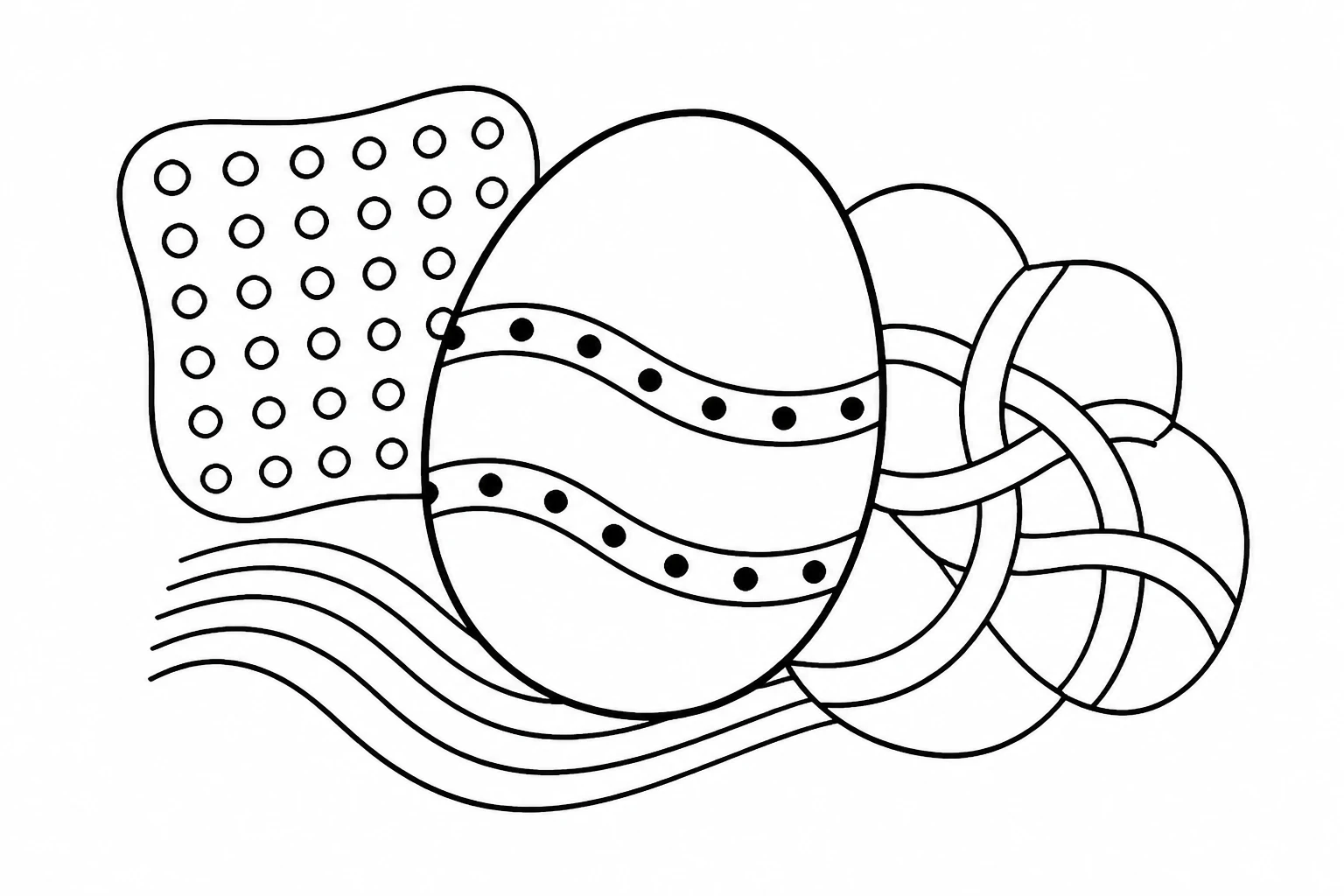
Ever notice how a simple Zentangle pattern can turn a blank page into a calm, creative moment?
The right doodle can feel like a mini meditation, letting worries melt away as ink meets paper.
Let’s explore ten easy patterns that are friendly for beginners yet striking enough to save or share on Pinterest.
Ready to start with a favorite, or simply skim to find your next doodle thrill?
1. Woven Dots and Lines Egg
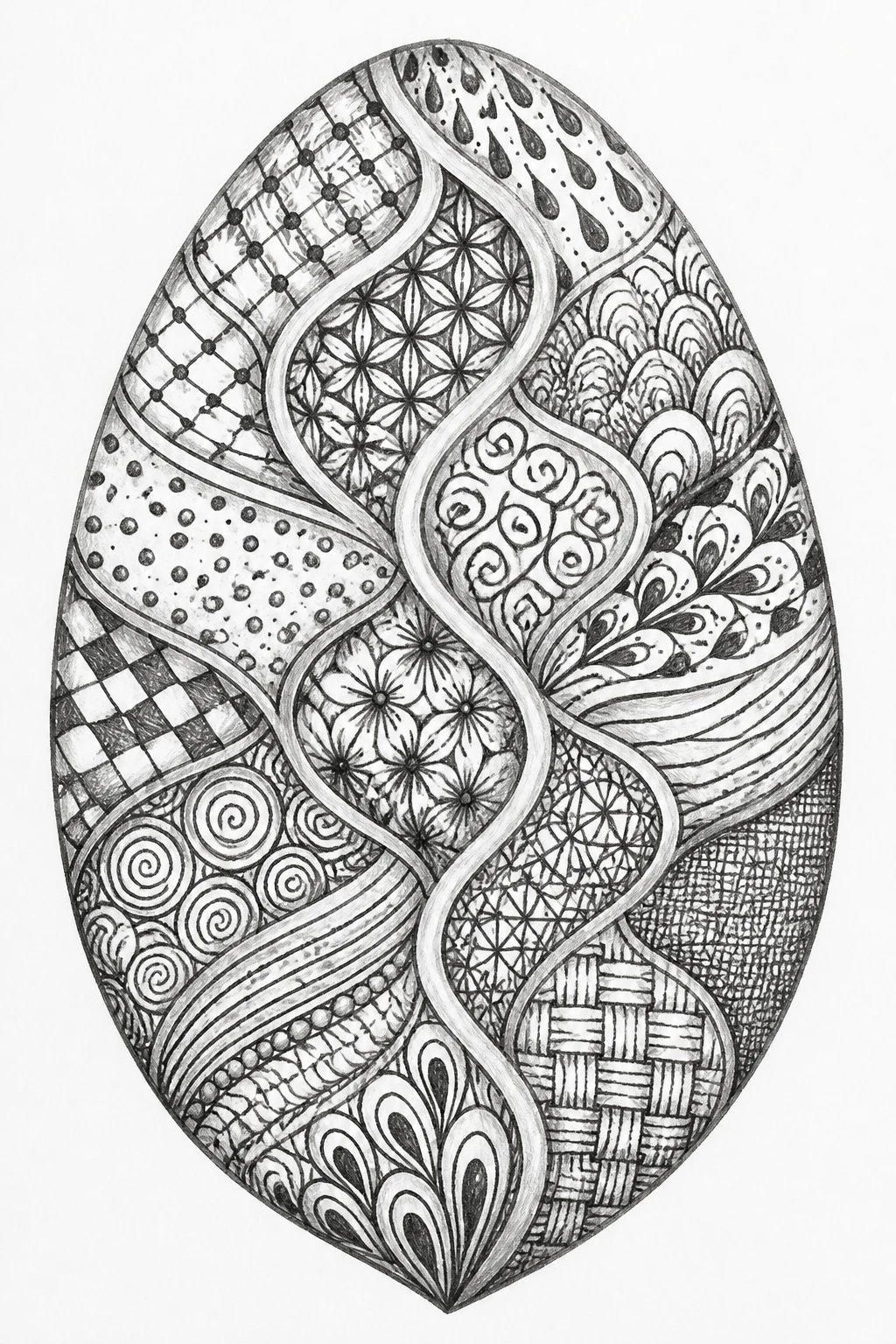
The egg shape feels inviting and friendly, and weaving tiny dots with curved lines creates a graceful Zentangle rhythm. It reads as a single, continuous surface rather than a busy collage, which makes it a satisfying focal piece for a doodle page.
How to Draw It
- Draw a soft oval with a slightly pointed bottom to form an egg silhouette.
- Inside the oval, create two parallel wavy lines that run from top to bottom, curving to mimic a woven pattern.
- Fill alternating sections with small evenly spaced dots or tiny hatch marks to imply texture.
- Keep the lines light at first, then thicken the outer boundary to reinforce the silhouette.
Minimal detail is key here; the rhythm comes from the interplay between negative space and the dot texture. This makes it ideal for a quick social pin or a meditative practice piece on a daily journal page.
2. Cloud Grid Zentangle
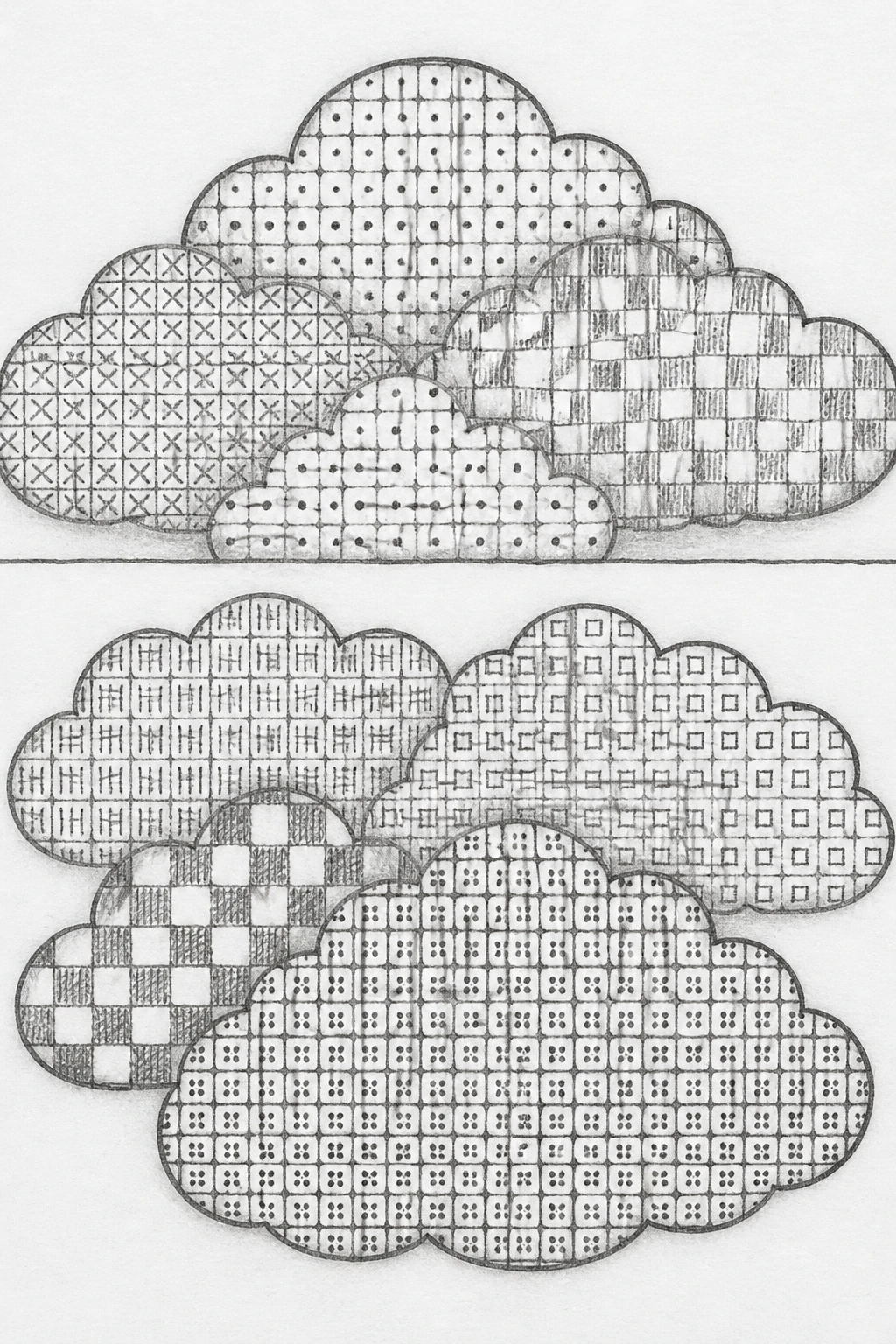
This pattern uses a light, airy silhouette by combining rounded cloud shapes with a grid of micro-tiles. The soft curvature contrasts with the neat grid, producing a calming yet contemporary look that feels both playful and organized.
How to Draw It
- Sketch a gentle horizontal line across the page to anchor the composition.
- Above and below, draw several overlapping circular cloud shapes with smooth curves.
- Within each cloud, insert a grid of tiny squares or rounded tiles, keeping spacing uniform.
- Optionally shade alternate tiles lightly to add depth without crowding the design.
One or two clouds may be enough for a single doodle or you can tile the page with this motif to create a calming background or a decorative border.
3. Lattice Leaf Row

A row of simplified leaves arranged in a lattice pattern offers a natural, botanical vibe without getting intricate. The clean stems and geometric leaf shapes create a symmetrical, almost architectural feel that readers find soothing and satisfying to replicate.
How to Draw It
- Draw a straight baseline and place a vertical stem line at regular intervals to form the lattice grid.
- On each node, sketch a small almond-shaped leaf leaning in alternating directions.
- Connect leaves with slender curving lines to create subtle arches in the lattice.
- Add light stippling or tiny veins in a couple of leaves for delicate detail.
The simplicity of the leaf shapes keeps the composition calm while the lattice structure provides pleasing geometry for a relaxing doodle session.
4. Crescent Wave Pattern

Soft crescents intersecting with gentle waves can feel like a tranquil tide on paper. This idea emphasizes smooth, flowing lines and repeating curves, which is perfect for slow, mindful drawing and easy Pinterest-ready silhouettes.
How to Draw It
- Begin with a horizontal baseline and draw a series of shallow arcs along it, forming a wave line.
- Above each arc, add a matching crescent that echoes the wave’s curve but faces the opposite direction.
- Between adjacent crescents, fill with short, evenly spaced hatch marks to imply texture.
- Keep line weight even and avoid adding extra details that might crowd the page.
The interplay of curves and space makes this pattern visually soothing while remaining highly reproducible across pages, stickers, and coloring sheets.
5. Minimalist Tile Flowers

Small, stylized flowers rendered as clean tiles create a gentle floral Zentangle vibe without getting too busy. This keeps the subject friendly for beginners while offering a classic, nature-inspired look that works well in journals or on social graphics.
How to Draw It
- Draw a short vertical stem with a tiny circle at the top as a bud.
- From the bud, sketch four simple teardrop petals radiating outward to form a compact flower tile.
- Place several tiles in a row or grid, letting a little space separate each bloom for airiness.
- Optionally add a few short lines at the base to hint at leaves or stems.
Keep petals identical or mirror them for symmetry. The result is a neat pattern that reads as both floral and Zentangle in a minimal form.
6. Zigzag Pebble Path

A line of tiny pebbles connected by short zigzags creates a grounded, earth-toned Zentangle motif. The pebble shapes are approachable, while the zigzag connectors introduce an element of rhythm that draws the eye along the page.
How to Draw It
- Draw a gently curved horizontal line as the path edge.
- Place evenly spaced rounded rectangles along the line to represent pebbles.
- Connect adjacent pebbles with a shallow zigzag line running through or between them.
- Shade alternating pebbles lightly to emphasize their individual shapes.
This concept feels meditative because it uses repetition and a soft transition of tones, making it ideal for a quick doodle break or a calming notebook spread.
7. Circular Mandala Slice
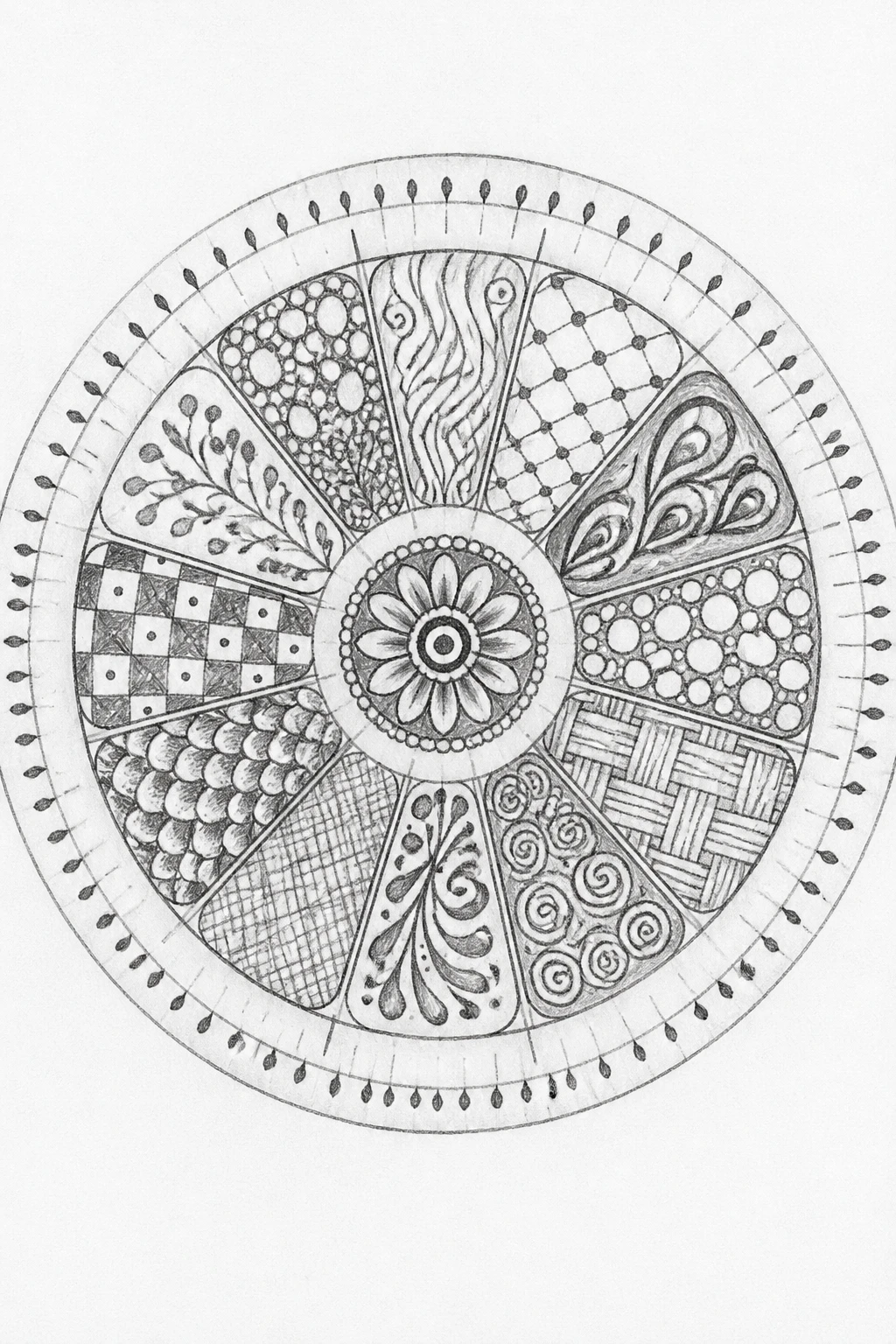
Think of a single circular segment from a mandala with bold, clean lines and a few inner rings. This is a scalable concept that can start as a tiny dot and grow into a bigger circular mandala, depending on your mood and time.
How to Draw It
- Draw a large, light circle to serve as the outer boundary.
- Inside, place two or three concentric rings with evenly spaced tick marks or tiny teardrop shapes.
- Within the inner ring, add a few short straight lines radiating outward to suggest segmented petals.
- Limit the design to one or two repeating motifs to retain a minimal look.
The key is keeping the inner details tight and uniform so the slice reads clearly when viewed at a distance or on a small screen.
8. Hexa-Stripe Grid

A clean hexagonal grid with parallel stripes creates a modern yet soothing Zentangle layout. The rigid geometry provides a satisfying sense of order, while the thin stripes offer visual interest without clutter.
How to Draw It
- Draw a honeycomb-like grid by creating hexagons with even spacing.
- Within each hexagon, draw one or two short parallel lines that run across the cell.
- Alternate line directions between adjacent hexagons to create subtle movement.
- Keep lines crisp and the fill very light for a breathable look.
This idea is especially good for pin-worthy borders or background patterns on a page while maintaining a minimalist Zentangle essence.
9. Teardrop Tide Lines
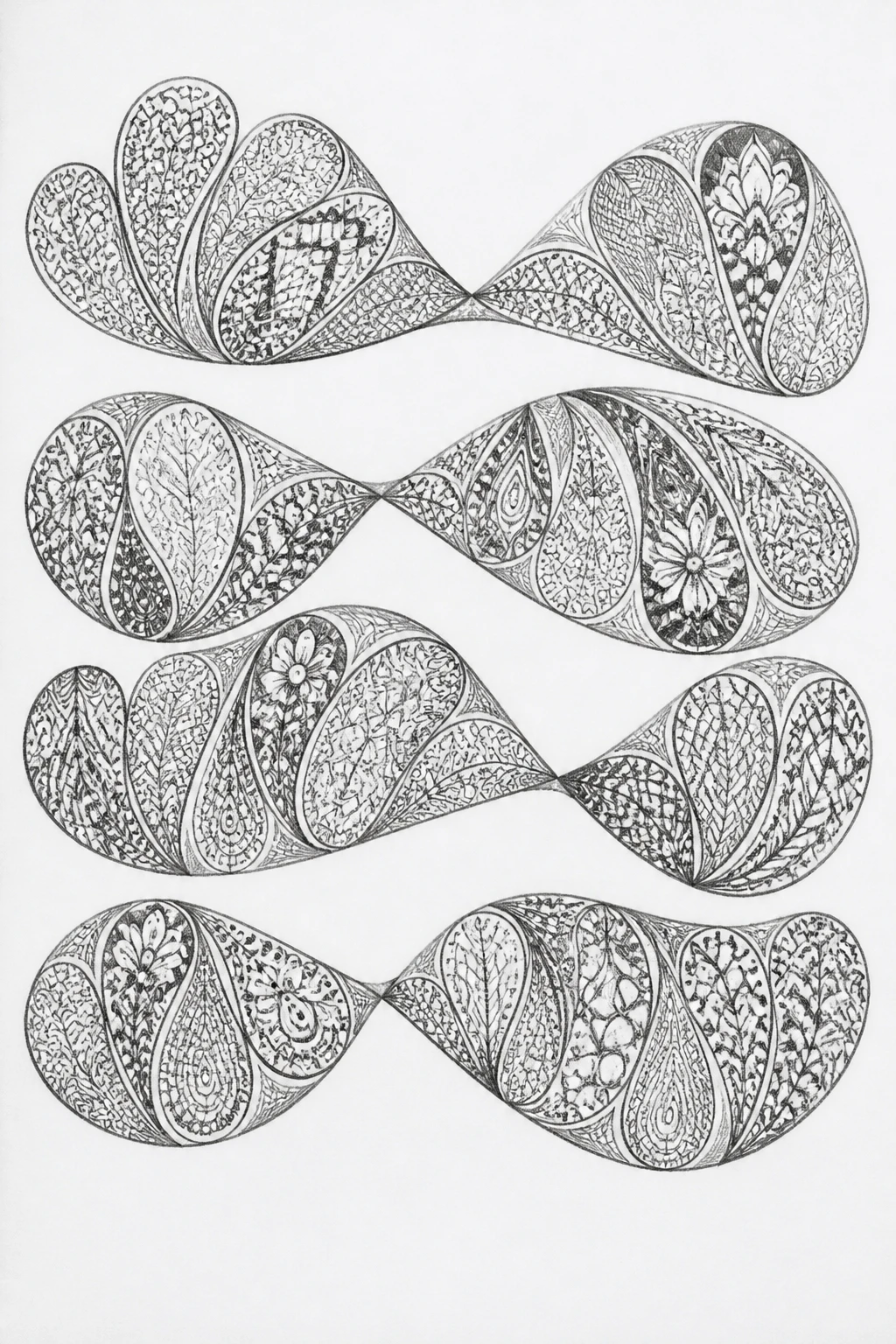
Repeated teardrop shapes oriented in a flowing tide-like arrangement offer a gentle, organic rhythm. The teardrop silhouette is instantly recognizable and easy to replicate, making this a quick but striking addition to any doodle page.
How to Draw It
- Draw a gently curved baseline and start with a teardrop shape pointing upward along the line.
- Stack teardrops in alternating directions so their points meet in a wave pattern.
- Keep the teardrops evenly spaced and the shapes uniform for a cohesive look.
- Add a thin shadow line along one side of each teardrop to give subtle depth if desired.
The result is a calm, billboard-ready pattern that remains minimal while delivering strong visual impact.
10. Tiny Arcs Garden

A miniature garden of arc shapes arranged like a neat row of hedges creates a charming, scalable Zentangle motif. The arcs form a continuous horizon, ideal for filler patterns around a central subject or as a compact standalone piece.
How to Draw It
- Draw a straight horizontal line as the ground or horizon.
- Above the line, sketch several small, shallow arc shapes in a row, touching each other lightly.
- Between arcs, add tiny dash marks or dots to imply texture or soil texture.
- Keep the arcs identical in curvature for a tidy, rhythmic look.
This concept is visually satisfying because of its single, repeating silhouette and the quiet sense of order it communicates on the page.
You May Also Like:
10 Zentangle Tangle Patterns for Beginners
15 Zentangle Doodle Designs With Simple Patterns
10 Zentangle Sketchbook Ideas for Creative Practice
Tips for Making Your Drawings Look Cute and Clean
Start by identifying the defining silhouette of each idea. A cloud grid relies on rounded shapes, a lattice leaf row on straight lines and leaf forms, and a teardrop tide on a flowing rhythm. Build those core shapes first, then add only a single, purposeful detail to enhance the design.
Keep generous white space around each subject. A strong silhouette with minimal internal clutter reads well on screen, in a notebook, or on a coloring page. If you plan to share on Pinterest, crisp edges and high contrast help your image stand out even in a crowded feed.
Quick Drawing Tips
- Use light guidelines for the initial shapes and then go over with a crisp final line.
- Maintain consistent line weight to preserve a cohesive look across ideas.
- Limit the number of interior details to keep the designs scalable for smaller screens.
- Experiment with single-stroke fills or hatch shading to preserve simplicity without losing depth.
- Practice each idea in a dedicated notebook page to observe your preferred composition and spacing.
Remember that the charm of Zentangle lies in repetition and rhythm. The fewer elements you stress about, the more meditative and satisfying the doodle becomes.
Pick Your Favorite and Start Drawing
You do not need perfect lines to create charming Zentangle patterns. Focus on the basic shapes, keep the details minimal, and let each subject maintain its own personality and silhouette.
Choose a favorite idea and give it a try in your sketchbook or on a fresh sheet of paper. Save the collection for your next relaxing doodle session, and feel free to adapt the designs while keeping each subject recognizable.
How to Make Your Zentangle Doodles Shine
Having ten ideas is great, but a few practical tweaks can turn a simple page into a gallery of ready-to-pin sketches. Start by planning your layout on a separate sheet before committing ink. A light pencil grid can help you align each idea with consistent margins, especially if you plan to print a mini zentangle mini-book for yourself or a class project.
Spacing matters. When ideas appear too close, your page can feel crowded even though each pattern is minimal. Give each section its own breathing room, and consider a soft decorative border around the page to unify the collection while keeping the minimalist trait intact.
Line quality is another big factor. If you are aiming for a crisp, professional look, practice drawing each motif with deliberate, confident strokes. A slightly heavier outline around the outer shapes can help the main subjects pop on a photograph or a screen capture, which is especially important for sharing on social media or Pinterest.
Printable pages or journal spreads benefit from a consistent color palette. You can start with black ink on white paper and add a touch of color using colored pencils or watercolor washes in limited tones. A restricted palette can make the entire set feel cohesive and easy to reproduce on multiple surfaces.
Practical Tips Summary
- Plan your layout with a light pencil guide before inking.
- Leave generous white space to keep each idea readable at small sizes.
- Maintain consistent line weight and proportion across all ten sections.
- Use a restrained color approach if you want color accents without overwhelming the designs.
- Photograph or screenshot your doodles against a plain background to enhance sharing quality.
Conclusion: Start with One, Enjoy the Flow
These ten ideas offer a compact, visually appealing set of Zentangle patterns that are perfect for relaxing doodle sessions. Each concept is designed to be beginner-friendly, quick to learn, and ready to adapt to your own style or sketchbook pages. The calm rhythm of lines and shapes can become a little daily ritual that you look forward to.
Pick one idea that resonates with your current mood, gather a pencil and pen, and begin. Remember that small imperfections are part of the charm and can make your doodles feel more personal. Feel free to save this article for later inspiration, or share it with a friend who loves simple, soothing drawing ideas. Happy doodling with your ten easy Zentangle patterns for relaxing doodle sessions.

Hi, I’m Abdul Moeed Shahid, the creator of Sketch and Fun. I’m passionate about helping people of all ages explore their creativity through fun drawing ideas and printable coloring pages. My goal is to make art simple, accessible, and enjoyable for everyone!